
We Know the Moon Better Than the Deep Sea
Despite extreme obstacles, deep-sea exploration is more important than ever
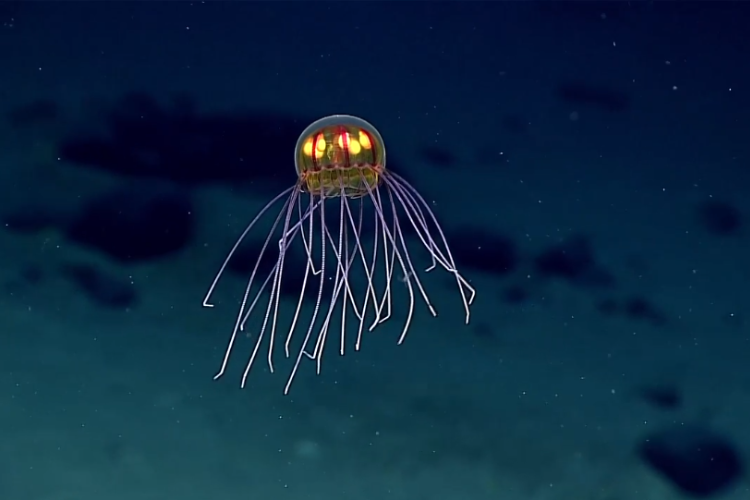
You may have heard: Scientists have more detailed maps of the moon than of the deep seafloor. This is because our moon is airless, waterless and directly observable from orbit, while the deep seafloor is hidden under miles of opaque ocean. The deep seafloor is also shockingly vast, covering over two-thirds of the Earth’s surface—roughly 10 times greater than the moon’s surface area. But visibility and size tell only part of the story.
So, what else makes the deep sea, which is sitting right in our own backyard, harder to explore than the moon, which is more than 200,000 miles away? How do scientists manage to study the deep sea despite the obstacles to observation? And why does deep-sea exploration matter now more than ever?
What is the deep sea, and why is it so hard to explore?
Extreme conditions make the deep sea the least-explored biome on Earth. The deep sea begins at 200 meters (656 ft.) below the surface, where sunlight all but disappears and the average temperature drops to 4°C (39°F).
Water pressure climbs fast, too, increasing by one atmosphere for every 10 meters (32.8 ft.) of descent. (An “atmosphere” is a standard unit of pressure defined as the average air pressure at sea level.) That means at 200 meters deep, you’d feel the equivalent of 21 atmospheres—one from the air above and 20 from the water around you.
The near-total darkness, freezing temperatures and crushing pressure, coupled with the sheer size of the ocean, make the deep sea incredibly difficult to study. As a result, scientists have visually observed less than 0.001 percent of the deep seafloor.
Stop Deep-Sea Mining
How scientists study the deep sea
While scientists have seen only a small portion of the deep sea, the study of this part of our ocean has come a long way over the last century.
In the late 1800s, the HMS Challenger expedition conducted the first comprehensive survey of the world’s oceans, using dredges and trawls to collect deep-sea samples. This laid the groundwork for modern oceanography.
From the early to mid-1900s, exploration shifted from direct human observation to indirect study with new tools. Technological advances like sonar allowed scientists to map the seafloor and sample its sediment without ever leaving the surface. The 1960s brought additional developments like remotely operated vehicles (ROVs), maneuverable underwater robots tethered to a surface vessel.
In the 1980s, Autonomous Underwater Vehicles (AUVs) took things further. These untethered robotic submersibles operate independently on pre-programmed mission profiles, enabling more sophisticated sampling and mapping of the ocean floor.
Today, a whole suite of technologies, including ROVs, AUVs and advanced underwater surveying methods, lets scientists study the deep sea more precisely than ever.
Why does deep-sea exploration matter?
We all depend on our ocean more than we realize, and studying the deep sea has never been this important.
Deep-sea observation systems, like the Ocean Observatories Initiative, track coastal environments, marine ecosystems and the powerful currents that drive our climate. This data helps scientists predict earthquakes, forecast storms, monitor fishery health and anticipate coastal flooding.
But our ocean faces growing threats, like deep-sea mining. This practice, which involves extracting mineral deposits from the ocean floor, is expanding rapidly worldwide and could cause major, irreversible environmental damage. Deep-sea mining threatens fragile ocean ecosystems and coastal communities by causing irreversible habitat destruction, disrupting fisheries and food security, harming biodiversity, and creating significant economic risks.
Ocean Conservancy is protecting our ocean from today’s greatest threats, and we need you in this fight. Take action now to help us defend our ocean against deep-sea mining.
Recommended Reads
