

Marine Carbon Dioxide Removal
Removing carbon dioxide from the atmosphere is a bold new ocean-based solution to reduce emissions being investigated
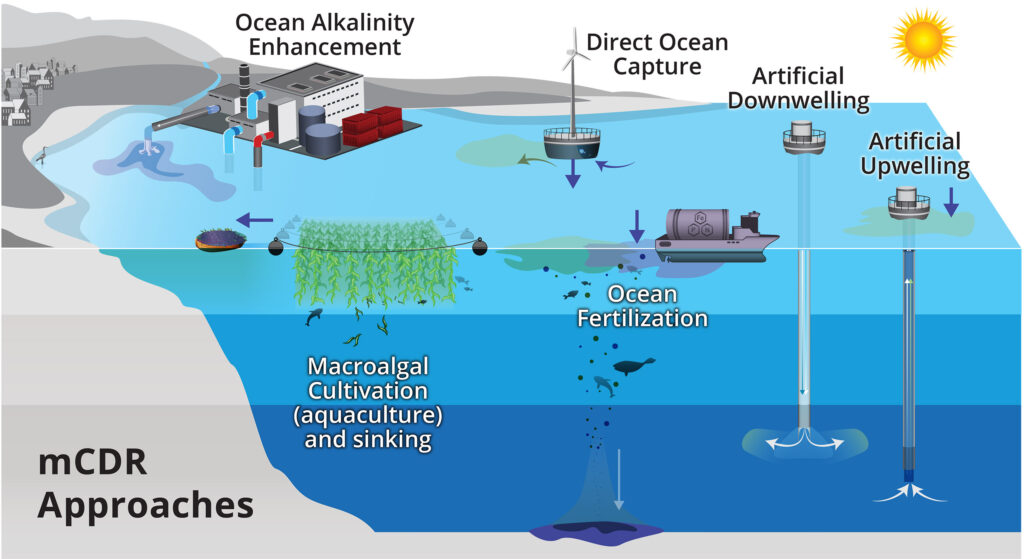
Bold, ocean-based climate solutions are being deployed now to reduce carbon emissions, such as expanding offshore wind energy and reducing emissions from the global shipping industry.Marine carbon dioxide removal (mCDR) has the potential to provide a complementary pathway to emission reductions by removing carbon dioxide from the atmosphere. mCDR leverages the ocean’s biological, physical and geochemical processes to take up atmospheric carbon dioxide (CO2). If successful, mCDR could remove up to 7-10gigatons of carbon dioxide from the atmosphere annually by 2050.
Climate change is already wreaking havoc on our ocean, just as it does on land—driving ocean heat waves, extreme weather, and ecosystem disruption. Nearly 200 countries adopted the Paris Agreement in November 2016, a legally binding international agreement to combat climate change. Its main goal is to hold the global average temperature increase to well below 2°C (3.6 °F), while pursuing efforts to limit it to 1.5°C (2.7 °F) above pre-industrial levels.
The smaller the temperature increase, the smaller the effects of climate change. Yet the sum total of all climate commitments made to date put the planet on track to warm 2.7°C (4.8°F) by 2100, meaning we will miss the Paris Agreement targets to limit greenhouse gas emissions.
The ocean is already a crucial ally for our climate. It produces half the world’s oxygen and absorbs more than 90% of the excess heat from climate change—and it has vast untapped potential to provide clean energy that reduces climate pollution, slows ocean warming and grows the economy.
While it is abundantly clear that we need to make rapid, ambitious emissions cuts, this is no longer enough to prevent the worst effects of climate change. Recent Intergovernmental Panel on Climate Change reports have stated that CDR will be essential to meeting Paris Agreement Targets.
As a result, there is increasing interest in not only finding ways to reduce greenhouse gas emissions but also in removing existing carbon dioxide (CO2) from the atmosphere.
While these techniques are promising, mCDR is still a relatively young area with so much left to discover. Ocean Conservancy is advancing consensus around responsible field research, ensuring inclusion of community voices and advancing governance and regulation conversations to ensure ethical research and trials. Oceans are our shared commons, and Ocean Conservancy recognizes the importance of insuring that any addition to or manipulation of our oceans must be informed by the best possible science with all voices at the table. Fortunately, mCDR research is at an early enough stage that the community can still gather evidence, utilize inclusive methodologies and understand different points of view. We can do this the right way, from the beginning.
Ocean Conservancy and mCDR
One way to support a coordinated, complex body of research on mCDR that also minimizes risk is to promote the use of a code of conduct for the field. A code of conduct, when uniformly adopted, is intended to minimize the risk of harmful consequences of field research while uncovering the needed information on the full scope of environmental and social outcomes of mCDR. Ocean Conservancy is engaging on how to make a code of conduct more useful for mCDR field research projects and larger deployments. Aspen Institute led the development of an mCDR code of conduct which was released in 2023 and Ocean Conservancy is participating in work focused on updating that work to help ensure broad adoption across the community.
Ocean Conservancy is also facilitating conversations across sectors (academia, government, industry and other NGOs) about next steps for good governance for mCDR and other relevant topics. International and national governance regimes for mCDR are still fragmented and rely on policies, rules and statutes set up to regulate other ocean issues. Private industry, academia and government scientists are together and separately conducting research across many countries.
It is already clear that CDR (terrestrial and marine) would need to be a complement, not a substitute, for rapid, ambitious emissions cuts. Some ocean-based climate mitigation solutions are being deployed now to reduce emissions, such as expanding offshore wind energy and reducing maritime shipping emissions. The benefits and risks of newer ideas like mCDR still need to be understood.
Solving the climate crisis requires bold, ambitious action. That is why Ocean Conservancy, along with our partners, is leading the charge on mCDR research to better understand these techniques and how they can help address the climate crisis.
Additional mCDR Resources
